2.1. Sudoku Notation#
Agreement on a notation to communicate Sudoku concepts avoids a Confusion of Tongues. This is my attempt to draw from what I consider best practices in the literature and put forward a precise, descriptive, comprehensive, consistent and unambiguous language for Sudoku. The notation is loosely based on and adapted from Sudopedia’s Diagrams and Notations.
2.1.1. Cells, Ccells, Houses and Chouses#
A Cell is a location on a Sudoku Grid. A Cell is present in the three Houses:, row, Column, and a Box.
A Ccell refers to any candidate in any cell as defined by its candidate value, row index and column index. That is, a Ccell is the unique reference to a specific candidate in a cell.
Ccells are three-dimensional tuples of value, row and column, each dimension ranging between 1 and 9. In Sudoku, 729 unique (9 value x 9 row x 9 column) possible Ccells exist. Ccells represent the remaining possible candidate values in a Cell
A solved Sudoku puzzle comprises 81 unique Ccells of the 729 unique possibilities. That is each cell in the 9 row by 9 column has only one value, all values in all cells obeying the Sudoku Rule.
The term Ccell is not to be confused with a:
Node: A further qualification of a ccell in a pattern such as a net or chain. For example: Ccells linked together in a chain form the Nodes between the links of the chain.
Candidate: A lesser reference to only the possible values in cells that obey Sudoku Rules.
Potential Elimination: A Synonym for Candidate, in the context of applying Conditional Logic: to reduce the set of Candidates in a Cell.
House is the collective noun for Row, Column, and Box, on a Sudoku grid.
2.1.2. Syntax#
2.1.2.1. Cell (Location) Specifiers#
The cell in location row 6, column 5 in the 9x9 cell grid |
|
The cells in box 4. |
|
The cell in box 4, position 5. Boxes and positions in boxes are
counted left to right then top to bottom, same location as
|
|
All cells in row 2 |
|
All cells in column 4 |
|
The grid of 6 cells |
|
A collection of cells in a comma separated list |
|
All cells in row 2 other than |
|
All cells in column 6 other than |
2.1.2.2. Ccell Specifiers#
The Ccell of value 3 in row 6, column 5 |
|
All Ccells with value 3 in row 6 |
|
A condensing of 3b6p2,4b6p2,7b6p2. Also, same as: |
|
Two or more ccells of value 3 found in any of |
|
One or more ccells of value 7 found in any of |
2.1.2.3. Ccell Postfixes#
The Ccell is a member of the odd parity Super Node in a SL Pattern |
|
The Ccell is a member of the even parity Super Node in a SL Pattern |
2.1.2.4. Pattern Combiners#
list ccell specifiers forming a pattern. |
|
list of related ccell patterns creating a larger pattern leading to an elimination or placement. |
2.1.2.5. Operators#
Placement of a value in a cell, eg. |
|
Elimination of a ccell or ccells - candidate(s) from a cell eg.
|
2.1.2.6. Conditionals#
Presence of only value or candidates in cells, e.g. |
|
Presence of only 2 or more of specified candidates in each
specified cell in a cell grouping, such that union of candidates
in specified cells match specified candidates. e.g.
|
|
Presence of at least the specified candidate(s) in cells e.g.
|
|
Presence of at least one instance of each specified candidate,
amongst other candidates in a cell grouping. e.g. |
|
Absence of candidate(s) in cells, eg. |
2.1.2.7. Relational Specifiers#
Count, e.g. |
|
Inference, e.g. |
|
House union, e.g. |
|
House intersections, e.g. |
|
Direct Strong Link between two Ccells. If X is True then Y is False and if X is False then Y is True |
|
Direct Weak Link between two Ccells. If X is True then Y is False and if X is False then Y is Unknown |
|
Strong Link masquerading as a Weak Link in a pattern |
|
Indirect Strong Link between two Ccells, resulting from a pattern |
|
Indirect Weak Link between two Ccells, resulting from a pattern |
|
(Indirect) Robust link between two Ccells. Opposite to a Weak Link, If X is True, then Y is unknown, and if X is False, Y is True |
|
Parenthesis - Distributive Property
|
|
Braces – Groupings of sub-patterns in Nets, etc. |
|
Square Brackets - To group sub-patterns of larger patterns |
|
Pointy Brackets - contain relationships between grouped sub-patterns |
2.1.2.8. Candidate Dressing#
Restricted Candidate, |
|
Unrestricted Candidate, |
2.1.2.9. Set Algebra#
X, Y and Z are Ccell members of Set A |
|
(Bar) Set Union Operator |
|
Set Intersection Operator |
|
(Dash) Set difference Operator |
|
Union of sets A, B, and C. |
|
Intersection of sets A, B, and C. |
2.1.3. Symantics#
Reading and interpreting this Sudoku language syntax is explained by examples. An appreciation of the meaning (semantics) of this syntax evolves through the balance of this section and the next. Albeit a comprehensive list, it is not an exhaustive treatise of all patterns, but hopefully a reference and enough to get a good understanding of the syntax mechanics.
Note:
Values always precede operators and/or cell specifiers when describing or specifying a pattern.
Values always follow an operator when cell(s) are being modified (either assigning a value or eliminating a Ccell).
A Ccell that is part of a structure such as a Chain or Net is always called a Node to distinguish it from other Ccells that are not part of the structure.
A Ccell that is part of a Set is called either a Member or Element of the Set to distinguish it from other Ccells that are not part of the Set.
2.1.3.1. Singles#
- Exposed Singles
3==r7c13 is the only candidate in r7c1 (and can be placed).
- Hidden Singles
3#1b7,b7p33 occurs only once in box 7, and that is in position 3
- Pointing Locked Singles
7r9c12,!-b77 occurs in r9, cells r9c1, and r9c2, and nowhere else in box 7, locking it to row 9
- Claiming Locked Singles
4r45c2,!-c24 occurs in column 2, cells r4c2 and r5c2, and nowhere else in column 2, locking it to box 4.
- Empty Rectangles
7#4b4,r4,c3;7r4c4=7r7c47 occurs 4 times in box 4 describing lines r4 and c3 and 7r4c4 is strongly linked to 7r7c4.
2.1.3.2. (Straight) Subsets#
- Exposed Pairs
56==r4c59Only Candidates 5 and 6 are only present in both r4c5 and r4c9 in row 4.
- Exposed Triples
14==r3c1,15==r3c5,145==r3c6Only candidates 1 and 4 are present in r3c1, 1 and 5 in r3c5, and 145 in r3c6, all in row 3
- Exposed Quads
5789==r4c4,579==r4c5,78==r4c6,5789==r4c8Only candidates 5, 7, 8 and 9 are present in r4c4, 5, 7, and 9 in r4c5, 7 and 8 present in r4c6, and 5, 7, 8, and 9 present in r4c8, all in row 4
- Exposed Locked Pairs
68==r89c1Only candidates 6 and 8 are present in r89c1 which lies in the intersection of column1 and box 7
- Exposed Locked Triples
345==r2c4,45==r2c5,35==r2c6Only candidates 3, 4, 5 are present r2c4, 4 and 5 in r2c5, and 3 and 5 in r2c6, all in row 2 and box 5,
- Hidden Pairs
45#2r3c38Candidates 4 and 5 only occur twice in r3, in cells r3c3 and r3c8. These candidates can be hidden by other candidates in those cells
OR
45!-r3c!38Candidates 4 and 5 are not present in row 3 outside of cells r3c3 and r3c8
- Hidden Triples
259!-r1c!135Candidates 2, 5 and 9 are not present in row 1 outside r1c1, r1c3 and r1c5
- Hidden Quads
2689!-r1c!1378Candidates 2, 6, 8 and 9 are not present in row 1 outside r1c1, r1c3, r1c7 and r1c8
2.1.3.3. Fish#
Note
In Fish ccell pattern specifications, the base set row or column always precede the cover set column or row. For example 3c47r26 finds the base sets in columns 4 and 7, and the cover sets in rows 2 and 6.
- X-Wings
5r26c69Candidate 5 is found twice in the base rows 2 and 6, which are covered by columns 6 and 9
- Swordfish
8c157r234 Candidate 8 is found two to three times in each base column 1, 5 and 7, which are covered by rows 2, 3, and 4
- Jellyfish
2r1469c1589 Candidate 2 is found two to four times in each base row 1, 4, 6, and 9 which are covered by columns 1, 5, 8 and 9
- Finned X-Wings
2c57r28,r79c5;2r8c6-2r7c5;2r8c6-2r9c5Candidate 2 is found twice in base columns 5 and 7, which are covered by rows 2 and 8. Base column 5 also has two fins in
r7c5and rowr9c5. Cover Ccell2r8c6sees both fins.
- Finned Swordfish
2r267c345 ,r7c6;2r8c5-2r7c6;2r9c5-2r7c6Candidate 2 is found two to three times in base rows 2, 6 and 7, that are covered by columns 3, 4 and 5. Base row 7 also has a fin
2r7c6. Cover Ccell2r8c5sees the fin.
- Finned Jellyfish
8r1358c4689 ,r8c7;8r7c9-8r8c7Candidate 8 is found two to four times in base rows 1, 3, 5, and 8, that are covered by columns 4, 6, 8 and 9. Fin
8r8c7exists in row 8. Cover Ccell8r7c9sees this fin.
- Sashimi X-Wings
2r69c2,r6c4,r9c5,r9c6;2r7c4-2r6c4;2r7c4-2r9c5;2r7c4-2r9c6Candidate 2 is found twice in base rows 6 and 9, that is only covered by column 4. Three fins exist,
r9c5andr9c6in base row 9 andr6c4in base row 6. Ccell2r7c4sees all fins.
- Sashimi Swordfish
6r258c69 ,r5c1,r8c2,r8c3;6r7c1-6r5c1;6r7c1-6r8c2;6r7c1-6r8c3;6r9c1-6r5c1;6r9c1-6r8c2; 6r9c1-6r8c3Candidate 6 is found two to three times in base rows 2, 5 and 8, that is only covered by columns 6 and 9. Three fins exist, r8c2 and r8c3 in base row 8 and r5c1 in base row 5. Ccells 6r7c1 and 6r9c1 see all three fins.
- Sashimi Jellyfish
7r1569c468 ,r9c7,r5c9;7r7c9-7r9c7;7r7c9~7r5c9Candidate 7 is found two to four times in base rows 1, 5, 6 and 9, that are covered by only three columns 4, 6, and 8. Two fins exist r9c7 and r5c7. Ccell 7r7c9 sees both Fins.
2.1.3.4. Bent Subsets#
- Y-Wings
23==r1c6,26==r1c7,36==r2c8;(3r1c8,3r2c6)-\3(r1c6,r2c8)Y-Wing spanning row 1 and box 3, with Unrestricted Candidate 3 in the pincers cells
r1c6andr2c8. Both3r1c8and3r2c6from outside the pattern see Unrestricted Candidate 3 in the pincers3r1c6and3r2c8.
- XYZ-Wings
359==r6c7,35==r6c8,39==r7c7;3r5c7-\3(r6c7,r6c8,r7c7)XYZ Wing spanning column 7 and box 7 with Unrestricted Candidate 3 in all three cells. 3r5c7 from outside the pattern see all Unrestricted Candidate instances - 3r6c7, 3r6c8 and 3r7c7.
- Bent Exposed Quads
459==r7c1,14==r7c5,45==r7c7,19==r8c4;(9r8c1,9r8c3)-\9(r7c1,r8c4)Bent exposed quad spanning row 7 and box 7, with Unrestricted Candidate 9. 9r8c1 and 9r8c3 from outside the pattern see all Unrestricted Candidate instances - 9r7c1 and 9r8c4.
- Grouped Bent Pair, Exposed Line, Hidden Box
U89r8c456,89==r8c1,89--r7c4Grouped Bent Pair with the union of candidates 8 and 9 in the intersection of row 8 and box 8 with exposed pair in row 8 and hidden pair in box 8.
- Grouped Bent Pair, Hidden Line, Exposed Box
U49r789c3,49==r8c2,49--r6c3Grouped Bent Pair with the union of candidates 4 and 9 in the intersection of column 3 and box 3. The exposed pair is box 3 and hidden pair in column 3.
- Bent Hidden Triples
18r7c3-189r7c7-89r4c7Bent Hidden Triple in made up candidates 1, 8, 9 in row 7 and column 7.
2.1.3.5. Inference Chains, Loops and Nets#
- Skyscrapers
2r5c9=2r7c9~2r7c4=2r6c4,2r5c9~2r6c8-2r6c4A four node SE-AIC, where both ends 2r5c9 and 2r6c4 form a Robust Link. 2r6c8 sees both ends resulting in its elimination.
- Two String Kites
3r2c1=3r2c6-3r3c5=3r8c5,3r2c1-3r8c1-3r8c5A four node SE-AIC, where both ends 3r2c1 and 3r8c5 form a Robust Link. 3r8c1 sees both ends resulting in its elimination.
- Turbot Fish
7r2c8=7r2c6-7r9c6=7r7c5,7r2c8-7r7c8-7r7c5A four node SE-AIC, where both ends 7r2c8 and 7r7c5 form a Robust Link. 7r7c8 sees both ends resulting in its elimination.
- Longer X-Chains
7r1c2=7r1c9-7r2c8=7r7c8-7r7c3=7r4c3,7r1c2-7r4c2-7r4c3A six node SE-AIC, where both ends 7r1c9 and 7r4c3 see 7r1c2, resulting in its elimination.
- Even X-Loops
3r2c4=3r2c8~3r3c7=3r5c7-3r4c9=3r4c4~,3r4c9-3r5c9-3r5c7A six (even numbered) node Even X loop where 3r5c9 can see two of the nodes, resulting in its elimination. Note the trailing - or ~ specifier back to the start indicating the chain loops back on itself with a weak link or masquerading as weak link respectively.
- Strong X-Loops
6r1c6=6r4c6-6r4c2=6r2c2-6r2c4=,6r4c6=6r1c6=6r1c6A five (odd numbered) node Strong X-Loop where 6r1c6 pivots on two strong links, resulting in its placement. Note the trailing = specifier indicating a strong link looping back to the start.
- XY-Chains
(8=3)r1c6~(3=4)r1c7~(4=5)r5c7-(5=8)r5c4,8r5c4-8r4c6~8r5c4An eight node XY Chain. Each cell only contains two nodes, a bi-value cell. Hence, the strong links of the AIC exist in the cells, and the weak links between the cells. 8r4c6 can see both ends of the chain, resulting in its elimination.
- XY-Loops
(4=7)r1c7~(7=9)r8c7~(9=8)r9c9~(8=4)r7c7~,9r9c9-9r8c9-9r8c7An eight node XY Loop. Each cell only contains two nodes, a bi-value cell. The loop causes all the links between cells to become strong. 9r8c9 can see both an odd numbered link 9r9c9 and an even numbered link 9r8c7, resulting in its elimination. Note the trailing - or ~ specifier back to the start indicating the chain loops back on itself with a weak link or masquerading as weak link respectively.
- Remote Pairs
(2=3)(r4c5~r4c9~r9c9~r7c7~r6c7),3r4c5-3r7c5-3r7c7A 5 Cell, 10 Node Net made up of same valued bi-value cells. 3r7c5 Can see both an odd and even parity Ccell in the net and can be eliminated.
- W-Wings
(8=9)r4c3~9r4c4=9r5c4~(9=8)r5c7,8r4c3-8r4c8-8r5c7A Conjugate Pair at the ends of a chain with the same End Node candidate value and the inner conjugate pair nodes see each other through an interior Strong Link. This pattern forms a Robust Link between the End Nodes. 8r4c8 can see both ends resulting in its elimination.
- AI-Chains
2r4c8=2r4c9-7r4c9=7r8c9-7r9c7=7r9c5-2r9c5=2r8c5,2r4c8-2r8c8-2r8c5- An 8 node AI-Chain forming a Robust Link between its ends, 2r4c8 and 2r8c5. 2r8c8 can
see both ends, resulting in its elimination.
- Even AI-Loops
1r4c5=1r6c5-1r6c8=3r6c8-3r4c7=3r4c5-,1r4c5-5r4c5-3r4c5,1r4c5-8r4c5-3r4c5,3r4c7-3r5c7-3r6c8,3r4c7-3r5c8-3r6c8,1r6c8-1r6c3-1r6c5A 6 node AI-Loop, strengthening the existing weak links. All Nodes that can see both an odd and even parity link can be eliminated, such as 58r4c5, 3r5c78, and 1r6c3.
- Strong AI-Loops
r8c9=1r1c9-6r1c9=6r1c8-3r1c8=3r7c8-3r8c9=,1r1c9=1r8c9=1r8c9A seven (odd numbered) node Strong AI-Loop where 3r8c9 pivots on two strong links, resulting in its placement. Note the trailing = specifier indicating a strong link looping back to the start.
- Group Linked Chains and Loops
8r3c23=8r2c3-8r8c3=8r8c9,8r3c23-8r3c9-8r8c9An group linked Turbot fish where the End Nodes 8r3c23 and 8r8c9 form a Robust Link. 8r3c9 can see both ends resulting in its elimination.
- Strong Linked Net
5r5c4e=5r6c4o=6r6c4e={6r6c8o,6r2c4o=6r1c6e=6r4c6o=9r4c6e=9r4c7o=9r5c9e=9r5c4o},9r1c9-9r5c9e,6r1c9-6r1c6eNote the braces grouping multiple subnet links to a parent. Also note the net level parity appended to each Ccell. All the candidates in a cell outside the net see even nodes (9r1c9-9r5c9e, 6r1c9-6r1c6e). If Even nodes are True, then none of the candidates in that outside cell can be True. This is a contradiction, the Truth set for that cell must contain at least one candidate. Therefore, all the Even Parity Nodes are False and can be eliminated. And, by implication, all the Odd Parity Nodes are True and can be placed.
2.1.3.6. Super Human Patterns#
- Kraken Finned Fish
2r69c12,r9c6;2r9c6-2r9c1=3r9c1-3r9c2=3r6c2-2r6c2=2r6c1-2r7c1In this Kraken Finned X-Wing, Candidate 2 is found twice in base row 6 and 9, which are covered by columns 1 and 2. A fin is present in
r9c6, seen by Ccell2r7c1through the WE-AIC:2r9c6-2r9c1=3r9c1-3r9c2=3r6c2-2r6c2=2r6c1-2r7c1.
- Kraken Sashimi Fish
2r13c5,r1c8,r3c9;2r1c8~2r1c5=7r1c5-7r1c7=6r1c7~6r9c7=6r9c9~2r9c9;2r3c9~2r9c9In this Kraken Sashimi X-Wing, Candidate 2 is found twice in base rows 1 and 3, and is only covered by column 5. Two fins exist
r1c8andr3c9. Ccell2r9c9sees2r3c9directly and2r1c8indirectly through the WE-AIC:2r1c8~2r1c5=7r1c5-7r1c7=6r1c7~6r9c7=6r9c9~2r9c9.
2.1.4. Outcomes#
- Placements
r3c5:=7Place 7 in cell
r3c5. Only a single value can be placed in a Cell
- Eliminations
r3c5-=7Remove candidate 7 from
r3c5, if present.r3c5-=237Remove candidates 2, 3, and 7 from cell
r3c5, if present.r3c789-=237Remove candidates 2, 3, and 7 from cells
r3c7,r3c8andr3c9, if present.r3c!(789)-=237Remove candidates 2, 3, and 7 from all cells in row 3 other than
r3c789.r8c456-=!(237)Remove all candidate other than 2, 3, and 7 from cell
r3c5.r8c!(456)-=!(237)Remove all candidate other than 2, 3, and 7 from row 8 other than
r8c456.b8p!(456)-=!(237)Remove all candidates other than 2, 3, 7 from box 8 other than
b8p456
2.1.5. Candidate Diagrams#
2.1.5.1. Candidate Representation#
Candidate Diagrams here vary from those described in Sudopedia and the Sudoku Forum.
The contents of a Candidate Diagram Cell is made up of the following components
Symbol |
Description |
|---|---|
X |
A unique but unspecified candidate value that may be present in that cell. |
(Underline). A unique but unspecified candidate value that that must be present in that cell. |
|
(Dashed underline). A unique but unspecified candidate value that may be present in that cell, and at least one of X must be present in their house. |
|
(Wavy underline). A unique but unspecified candidate value that may be present in that cell, but at least two of X must be present in their house. |
|
+ |
An appended “+” indicates the presence of other candidates. A “+” on its own indicates any candidates including those in the pattern may or may not be present in that cell. |
(Overline). Not X. X must be absent from that cell. |
|
(Strikethrough). If candidate is present in that cell it can be eliminated. |
|
X* |
(Wildcard) Any candidate but X can be eliminated from that cell. |
Expression |
Description |
|---|---|
+ |
Any candidate including those in the pattern being considered, may or may not be present. |
X+ |
X may be present, optionally other candidates too |
X and Y are the only two candidates in that cell |
|
X and Y must be in that cell, optionally other candidates too |
|
XY |
X and Y are the only two candidates in that cell (synonym of |
XY+ |
X and Y must be present, optionally others (synonym of |
XYZ |
At least two of X, Y and Z are the only candidates present in that cell |
XYZ+ |
At least two of X, Y, and Z are present, optionally other candidates too |
X and Y must be present, optionally Z only |
|
X, Y and Z are the only candidates present in that cell |
|
X, Y and Z are present, optionally other candidates too |
|
WXYZ |
At least two of W, X, Y, and Z are the only candidates present in that cell |
WXYZ+ |
At least two of W, X, Y and Z are present, optionally other candidates too. |
W and X must be present, optionally Y and Z only |
|
W, X and Y must be present, optionally other candidates too |
|
W, X, Y and Z must be the only candidates present |
|
W, X, Y and Z must be present in that cell, optionally other candidates too |
|
X* |
Any candidate other than X can be eliminated |
XYZ* |
At least one of X, Y, and Z is present and any other candidate can be eliminated |
X and Y must be present, optionally Z, and any other candidate can be eliminated |
Many patterns rely on the presence of Candidate values anywhere in the intersection of a line and a box. For these patterns, Candidate Diagrams merge the three cells in the intersection into one larger cell containing the union of the Candidates in the intersecting cells.
2.1.5.2. Some Examples#
2.1.5.2.1. Locked Exposed Pair#
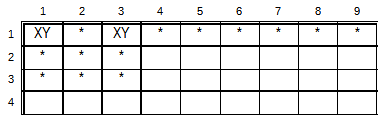
Figure 2.1: Locked Exposed Pair Pattern#
XYr1c13. The exposed pair XY is confined to the intersection of r1 and b1. * indicates all the cells that
can see the cells of the exposed pair. If X or Y exists in the cells with a *, they can be eliminated.
2.1.5.2.2. Y-Wing#
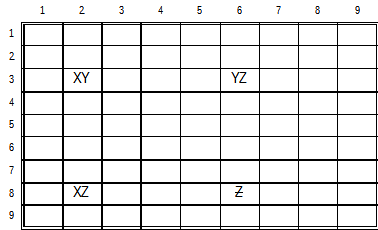
Figure 2.2: Y-Wing Pattern#
XYr3c2 locks the Truth Z(r8c2,r3c6) in both pincers, so any Ccell like Zr8c6 that
ees both pincers cannot be true and is eliminated.
2.1.5.2.3. Locked Pointing Single#
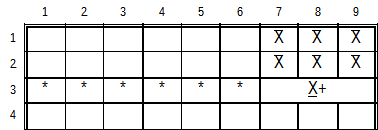
Figure 2.3: Locked Pointing Single Pattern#
X is present in the intersection of row 3 and box 3, and not present in the rest of box 3. Therefore, X must be True in the intersection resulting in the elimination of X along row 3 outside the intersection.
2.1.5.2.4. XYZ-Wing#
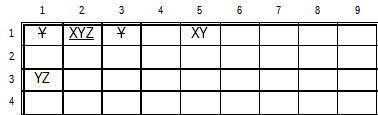
Figure 2.4: XYZ-Wing Pattern#
XYZr1c2 in the intersection of ensures that the Unrestricted Candidate, Y, must be True
in at least one of the cells forming the pattern. Therefore, any other candidate Y that
can see all occurrences of Y in the pattern can be eliminated. The only locations that
can see all the pincers and pivot lies in the intersection of row 1 and box 1.
2.1.5.2.5. Locked Exposed Triple#
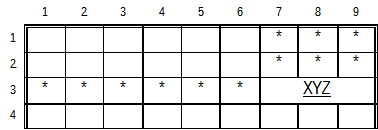
Figure 2.5: Locked Exposed Triple Pattern#
X, Y, Z are the only candidates confined (locked) to the intersection of row 3 and box 3, with no other candidates, they identify an Exposed Triple. X, Y, Z are True in the cells of the Exposed Triple, therefore any Ccells that can see all the same value Ccells in the Exposed Triple cannot be True and can be eliminated.
2.1.5.2.6. Swordfish#
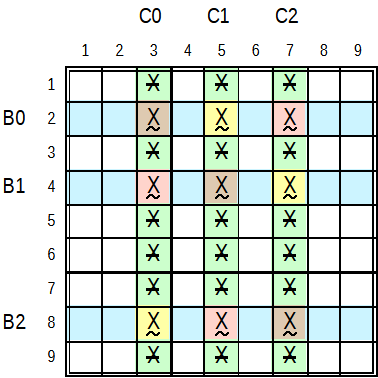
Figure 2.6: Swordfish#
Base sets B0, B1, and B2 with at least 2 instances of X align such that each of the three cover sets sees at least two ccells in their three intersectons. This locks the Truth to the intersecting cells. Therefore any instance of X along the covers outside the intersections cannot be True and is eliminated.
2.1.5.2.7. Finned Swordfish#
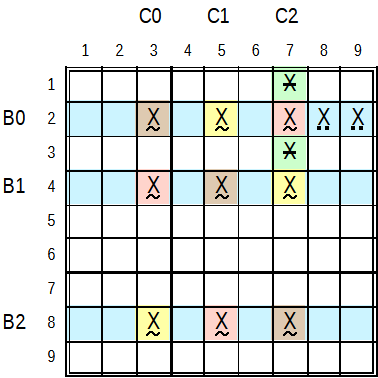
Figure 2.7: Finned Swordfish#
Base sets B0, B1, and B2 with at least 2 instances of X align such that each of the three cover sets sees at least two ccells in their three intersections. But B0 has two fins Xr2c89. So either the Swordfish is the Truth or one of the fins are True. Therefore, any instance of X in the covers outside the intersection, that can see the fins cannot be true and is eliminated.
2.1.6. Other Notations#
2.1.6.1. Candidate Grids#
Also known as Pencilmark Grids or PM Grids.
.---------------------.---------------------.---------------------.
| 2      56789  578   | 34569  345789 456789| 1     *467    679   |
| 1      4      57    | 569    2      5679  | 679    8      3     |
| 679    6789   3     | 469    1      46789 | 5     *2467   2679  |
:--------------------- --------------------- ---------------------:
| 3457   12357  2457  | 34569  34589  45689 | 46789 -12467  126789|
| 34     123    6     | 7      3489   489   | 489    5      1289  |
| 8      57     9     | 2      45     1     | 3     -467    67    |
:--------------------- --------------------- ---------------------:
| 45679  56789  4578  | 459    4579   3     | 2      167    15678 |
| 45679  5679   1     | 8      4579   2     | 67     3      567   |
| 357    23578  2578  | 1      6      57    | 78     9      4     |
'---------------------'---------------------'---------------------'
A ‘*’ is prefixed to the candidate’s string in the pattern that cause the elimination or placement. A ‘-’ is prefixed to the candidate to be eliminated’s string.
There are many variations in pencil mark grids. Sometimes the symbol may be appended instead of prefixed, sometimes symbols are placed in the middle of a of candidate strings to indicate the candidates are relevant or those to be eliminated or placed like below.
.---------------.---------------.---------------.
| 6    9    3   | 7    4    8   | 25   25   1   |
| 1    4    5   | 69   2    3   | 69   7    8   |
| 7    2    8   | 1    5    69  | 3    69   4   |
:--------------- --------------- ---------------:
| 35   1357 6   | 389  178  2   | 589  4    579 |
| 4    13-7 9   | 368  1678 5   | 268  268  27  |
| 8    57   2   | 469  679  469 | 1    569  3   |
:--------------- --------------- ---------------:
| 2    58   1   | 459  89   49  | 7    3    6   |
|*59   568  4   | 568  3    7   | 2589 1   *59+2|
|3*59  3568 7   | 2    68   1   | 4    589 *59  |
'---------------'---------------'---------------'
For more complex techniques where the ‘*’ symbol is not sufficient to indicate the cause of the eliminations, or when illustrating multiple techniques causing multiple eliminations in a single diagram, other symbols such as ‘#’ and ‘@’ can be used.
If the logic behind the eliminations involves only a single digit, say the digit 4 in this case Some people choose to communicate the same message by showing only the cells with 4 as a candidate, like the one shown below. This kind of grid tend to be much easier to read than the grid showing the entire pencilmarks.
.---------.----------.----------.
| .  .  . |  4  4  4 |  . *4  . |
| .  .  . |  .  .  . |  .  .  . |
| .  .  . |  4  .  4 |  . *4  . |
:--------- ---------- ----------:
| 4  .  4 |  4  4  4 |  4 -4  . |
| 4  .  . |  .  4  4 |  4  .  . |
| .  .  . |  .  4  . |  . -4  . |
:--------- ---------- ----------:
| 4  .  4 |  4  4  . |  .  .  . |
| 4  .  . |  .  4  . |  .  .  . |
| .  .  . |  .  .  . |  .  .  . |
'---------'----------'----------'
2.1.6.2. Sets#
FIXUP
From Allan Barker’s site.
Eliminations are written in standard notation except for sets, which are written in a form that makes them easy to recognize. The notation follows the definition of Sudoku sets in 3D, and adds an extra number so that row 4 contains row sets r41 to r49. The extra number is the digit except for cell sets, which are noted by row and column. The four types of sets are then:
row = R(row, digit), column = C(column, digit), cell = N(row, column), box = B(box, digit)
Subgroups like c51, c53, and c59 are written as c5(139). The short notation is meant for use with diagrams that provide exact candidate details. However, set theory says that all eliminations can be understood based on sets alone without candidate details, in principle.
An example elimination expression is:
Rank 1: [r46 c5(139) c76 n23 n3(12)](ST) r26*c56 => r2c5 <> 6
which is of the form:
<rank>: [list of covering sets](triplet info)<overlap linksets> => <assignments>,<eliminations>
In some cases <overlap linksets> is replaced with [list of covering linksets], particularly for rank 0 logic (like fish) where all linksets can cause eliminations. The triplet information denotes the presence of triplets, where T means a linkset Triplet and S means a Set triplet.
S4=[r(28)6 c26 b56], L6=[r(56)6 c(459)6 b76] => r6c9<>6
S23=[r(27)2 r(148)4 r35 r19 c8(39) n(379)2 n83 n(27)5 n96 b15 b2(28) b3(16) b74 b97], L28=[r2(16) r38 r7(34) r9(67) c14 c28 c3(45) c58 c6(258) c74 n31 n34 n15 n17 n(1379)8 n89 b1(24) b71] => r3c1<>4
2.1.6.3. Chains#
FIXUP
Links with strong inference are represented by =X=, where X is the digit. Links with weak inference are represented by -X-. To make a distinction between continuous and discontinuous loops, a single dash or equal sign is placed at the start and end of the loop to indicate how it continues.
=[r1c1]-1-[r4c1]=1=[r4c5]-1-[r1c5]=1=[r1c1]-
These continuation markers are not present in discontinuous loops.
[r1c1]-1-[r4c1]=1=[r4c5]-1-[r5c6]=1=[r1c6]-1-[r1c1]