2.5. Truth, Sets and Fish#
2.5.1. Truths#
A Truth is a Set of Ccells in a Chouse that see each other. One of the Ccells in any truth Set is True, that is the solved value for that Cell.
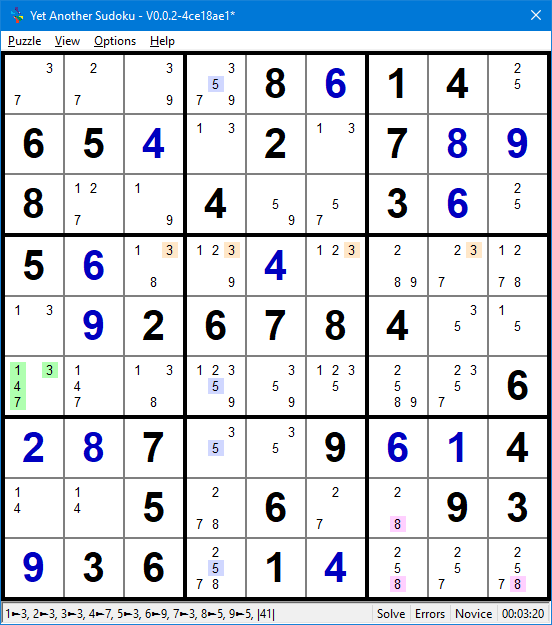
Figure 2.10: Truths#
Truth Examples:
In Row 4,
3r4c3468is all cells containing candidate 3.In Column 4,
5r1679c4is all the cells containing 5.In Box 9,
8b9p479is all the cells in box 9 containing 8.In Cell
r6c1,1347r6c1is all the possible values in that cell.
2.5.2. Sets#
- See
Ccells that have an Link between them are said to see each other.
- Set
- Truth
A collection of Ccells that See each other in a Chouse where one of the Ccells is True, that is the Solved Value.
- Base Set
A Base Set is a Set of one or more Ccells in a Chouse forming a Truth.
- Link Set
A Set of one or more Ccells in a non-Base Set Chouse that are in any Base Set.
- Cover Set
A Cover Set is a Set of all the Ccells that See each other in the Chouse of a Link Set.
A Set pattern comprises ‘n’ non-intersecting Base Sets where Ccells in the union of Base Sets, are intersected by Link Sets. If the number of Base Sets = the number of Link Sets then every Base Set Truth can be seen in a Link Set, thus locking the patterns making the whole pattern a Collective Truth. Ccell that are not part of the intersection in any Cover Set cannot be True and are eliminated.
2.5.3. Subsets#
Subsets refer to ‘n’ cell by ‘n’ candidate grouping, where each cell in the grouping contains between 2 and ‘n’ of the candidates. ‘n’ ranges between 2 and 4, (pairs, triples and quads). For values of “n” > 4, a reciprocal subset relationship of 9 – ‘n’ candidate values exists, so it is unnecessary to look for subsets larger than 4.
2.5.3.2. Straight or Bent#
Subsets can be Straight or Bent:
2.5.3.3. Straight Subsets#
In Straight Exposed Subsets, the ‘n’ candidates can each only be True in one of the ‘n’ cells in a House they occupy. That is the n Candidates are a Truth for those n cells. Therefore, they cannot be True outside those ‘n’ cells. Any occurrence of those ‘n’ candidates outside the ‘n’ cells can be eliminated.
In Straight Hidden Subsets, the ‘n’ candidates are confined to only ‘n’ cells in a Group, forming a Truth. Because of this ‘Truth’, any other candidates in those four cells can be eliminated.
Base Sets and Cover Sets develops an algebra to verify the logic of these Subset patterns.
See Human Solvable Patterns / Subsets for worked examples of Exposed and Hidden - Pairs, Triples and Quad (Unbent) Subsets.
2.5.3.4. Bent Subsets#
These patterns comprise ‘n’ candidates in ‘n’ Cells with 2 to ‘n’ candidates in each cell spanning two intersecting Houses with at least one cell in the intersection. Bent Exposed Subsets can only have one Unrestricted Candidate to be viable, the remaining candidates being Restricted Candidates.
Candidates can be exposed or hidden in either house.
Bent Subsets where candidates are exposed in both houses are often called Wings. The smallest of these being Y-Wings and XYZ Wings (collectively termed Bent Exposed Triples) with one part of the pattern in either house and the third in the intersection of both houses locking the pattern.
These patterns are a special case of Nearly Locked Sets, where two ULSs are linked in a chain with a single Unrestricted Candidate. Bent Exposed Subsets have a relatively high probability of occurrence in puzzles and are relatively easier to master than the more complex Unlocked Sets, YMMV.
2.5.3.4.1. Restricted and Unrestricted Candidates#
A Restricted Candidate is one where all instances of its value in a pattern can see each other. An Unrestricted Candidate is one where all its instances of its value do not see each other.
A Bent Exposed subset must have only one Unrestricted Candidate to be viable. The other Candidates are all Restricted. The Unrestricted Candidate must have an instances in Pattern Cells of both Houses outside the intersection and may have instances in Pattern Cells in the Intersection. The Restricted Candidates are only present in pattern cells in that are fully in one House or the other.
The Unrestricted Candidate can be True in at least one or both Houses, but can never be False in both. Therefore, any Ccell outside the pattern that can see all Unrestricted Candidate instances in the Cell Pattern cannot be True, resulting in their elimination.
2.5.4. Nearly Locked Sets#
FIXUP Take from all the notes from ALS, ULS in sudoku.odt. Conceptual stuff here, details and examples in :ref:` Patterns <hsp_nls>`
2.5.5. Fish#
Fish are single Candidate Base Set / Cover Set patterns where both Base Sets and Cover Sets are Houses.
- Fish are named according to their Base Set count:
2: X-Wing
3: Swordfish
4: Jellyfish.
Every Fish with a Base Set count ‘n’ has a reciprocal Fish pattern exists of count 9 - ‘n’, thus, making it unnecessary to look for Base Set counts greater than 4.
- Consider a single candidate value X, where X is a number between 1 and 9. Fish pattern is made up of:
‘n’ non-intersecting Houses containing between 2 and ‘n’ instances of X as the Bases,
where all instances of X in each Base Set Links to another instance of X in another Base Set.
The houses containing these links form the Cover Sets.
From Base Sets and Cover Sets above, we have shown that any instance of X in the Cover Sets that is not part of the intersection is not part of the Truth, and can be eliminated.
Basic Fish patterns have either row Base Sets and column Cover Sets or vise-versa.
Fish may be degenerate. Often it is possible to eliminate of candidates from these degenerate fish. Finned Fish have an extra Ccell or two in one of the Base Sets. Sashimi fish are missing a Ccell in one of the Base Sets. Finned Sashimi fish have an extra Ccell in one Base Set and are missing Ccell in another Base Set.
Fraken and Mutant Fish are more complex Fish patterns. Fraken Fish have one or more Box Base Sets. Mutant fish have a combination of non-intersecting row, column and box Base Sets. In both Franken and Mutant Fish, Cover Sets can be in any House type. Fraken and Mutant fish can be degenerate too (Finned and or Sashimi).
Kraken Fish, are degenerate fish where eliminatable candidates in the Cover Sets see all the fins with AIC chains if it cannot see them directly.
Franken, Mutant, and Kraken Fish border on what is considered human solvable.