3.8. Base, Link, and Cover Sets#
- This section owes much credit to:
3.8.1. Introduction#
3.8.1.1. Some Definitions#
- Cell
A location in a Sudoku grid which either contains a Given or into which a Solved Value is placed.
- Ccell
A three-dimensional tuple uniquely identifying a candidate element by value, row, and column in a Sudoku Grid.
- House
A specific 9 cell of a Row, column or Box. Also known as a Group, Sector or Unit.
- Chouse
- See
Ccells that have an Link between them are said to see each other.
- Set
- Truth
A collection of Ccells that See each other in a Chouse where one of the Ccells is True, that is the Solved Value.
- Base Set
A Base Set is a Set of one or more Ccells in a Chouse forming a Truth.
- Link Set
A Set of one or more Ccells in a non-Base Set Chouse that are in any Base Set.
- Cover Set
A Cover Set is a Set of all the Ccells that See each other in the Chouse of a Link Set.
3.8.1.2. Base Set Cover Set - X Wing Example#
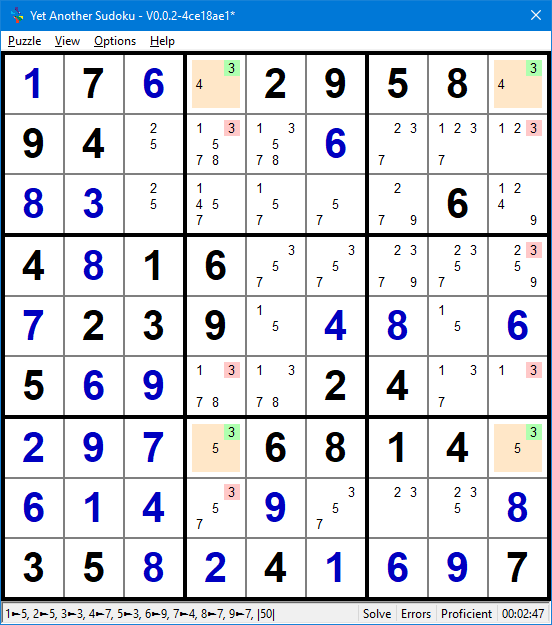
Figure 3.47: Base, Link and Cover Set Example#
In Fig Figure 3.47:
Column 4 is a Link Set connecting
3r1c4and3r7c4from the Base Sets.Column 9 is also a Link Set connecting
3r1c9and3r7c9from the Base Sets.Column 4 is also a Cover Set including all Ccells that see the Link Set, that is
3r12678c4.Column 9 is also a Cover set including all Ccells that see its Link Set that is
3r12467c9Because all the Base Ccells are covered by Cover Ccells, the intersecting Ccells are confirmed as a Truth in the Cover Sets. Thus, resulting in the elimination on non-intersecting Ccells in the Cover Sets,
(r268c4,r246c9) -= 3
3.8.2. Single Base Set Patterns#
A single Base Set, with a single Ccell Truth. Ccells in Intersecting Cover Sets outside the intersection are eliminated. Because the Base Set is a Single Ccell, the whole Truth of the Base Set can be seen from any other Chouse.
Exposed Singles, Hidden Singles, and Locked Singles are examples of Single Order Patterns.
Expressing the Sudoku Rule as a Formula for Single Order Patterns using Set Algebra:
Base Set  B  = {P}    # P is the only Ccell Truth in the Base Set B
Cover Set Cj = {S, T, V, ...}    # S, T, U, ... are the Ccells that see P in Cover Setj.
Cover Set CU = U(C0, C1, ...)    # C is the union of Cover Sets C0, C1, ...

IF (B & CU == B):    # if all the Cover Set Ccells intersect Base Set Ccells
   THEN Elims = CU - B    # Then Eliminate all Cover Ccells not in Base Sets
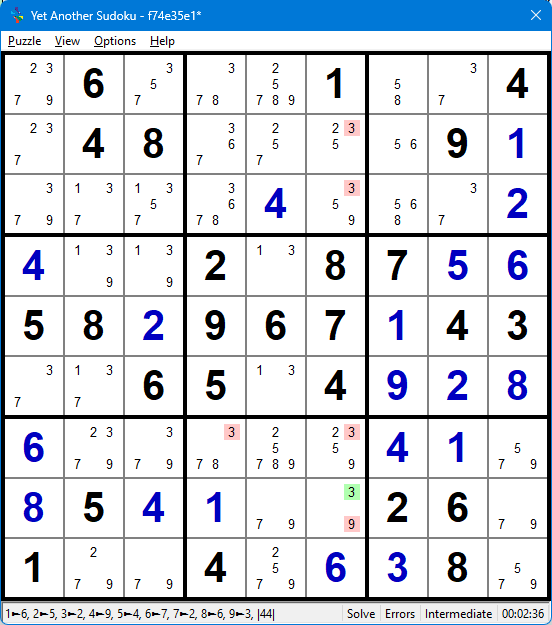
3.8.3. Multi Base Set Patterns and Rank#
Multi Base Set Patterns have more than one Truth, each in a Base Set, that is confirmed as a collective Truth. If all the Ccells in these Truths can be linked orthogonally (intersected by Ccells in non-Base Set Chouses) in Link Sets, then parts of the pattern are locked as a collective Truth. Cover Sets include all Ccells in the Chouse of the Link Set that see all the Link Set Ccells.
Where a collective Truth exists, eliminations, if any, are the non-Base Set Ccells in the intersection of Cover Sets overlapping the collective Truth.
Rank is the minimum number of Link Sets needed to intersect all Base Set Ccells, less the number of Base Sets.
Multi Base Set Patterns are classified according to Rank.
Rank < 0: Without additional crieria, it is impossible to lock further Truths. Look to Allan Barker’s General Logic of Sudoku’s section on Illegal Logic for more information.
Rank = 0: All Ccells in ‘n’ Base Sets are Intersected by at least ‘n’ Link Sets. Any Cover Set Ccell that is not in a Base Set cannot be True and is eliminated.
Rank > 1: ‘n + r’ Link Sets are required to Intersect all the Base Set Ccells. Any non Base Set Ccell in ‘r + 1’ Cover Sets cannot be True and is eliminated.
3.8.3.1. Rank 0 Patterns#
Rank 0 patterns have ‘n’ non-intersecting Base Sets where all their Ccells are intersected by a minimum of ‘n’ Link Sets, thereby Locking the pattern as a collective Truths. Any Ccell in a Cover Set that is not part of the Intersection cannot be True and is eliminated.
Rank 0 patterns include Singles in all there forms, Straight Subsets, Fish, and Even Loops.
Singles are Single Base Set Patterns, a special case of Rank 0 patterns with a single Ccell Truth. A Single CCell Truth can never need more than one Link Set to intersect it completely as there is only on Ccell to overlap. Therefore, Singles are always Rank 0.
Exposed Subsets have Base Set Cells, and Link Sets all in a same House type (Row, Column or Box). Hidden Subsets have Base Sets in the Same House Type, and Link Sets in Cells.
Fish are single digit patterns with non-Intersecting House Base Sets that can Overlap, covered by the same of House Link Sets.
An Even Loop is a AI chain with an even number of Nodes that loops back on itself. The Strong Links from Base Sets, connected by the Weak Link Cover Sets. Because the Loop is Closed, a collective Truth is locked into the pattern.
3.8.3.1.1. Rank 0 Exposed Quad Example#
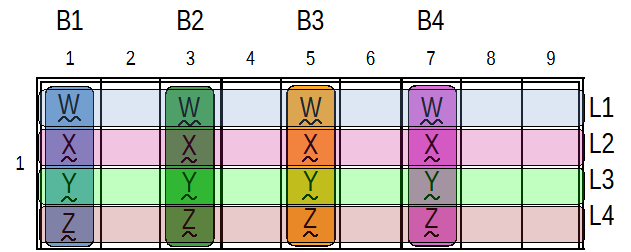
Figure 3.49: Exposed Quad Pattern#
In the Exposed Quad Figure 3.49: , B1, B2, B3, B4 are Base Sets, each containing two or more instances of values W, X, Y, and Z; such that each of the 4 Link Sets see two or more instances of each value W, X, Y, Z. That is, L1 sees all the W’s present in B1, B2, B3, B4; L2 sees all the X’s, L3 all the Y’s and L4 all the Z’s. Therefore, by virtue of L1, L2, L3 and L4, each intersecting all the Base Sets, they hold the Truths for W, X, Y and Z respectively in that house. W, X, Y, and Z cannot be True anywhere else in this House and are Eliminated.
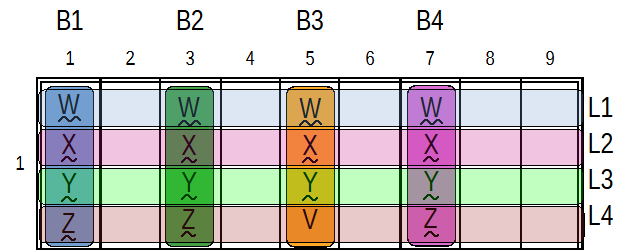
Figure 3.50: Not Quite an Exposed Quad Pattern#
Figure 3.50: has a V instead of a Z in B3. Here candidate V remains uncovered after the Link Sets have been applied. Either the remaining Exposed Quad is True, or V is True. But which it is, is undetermined. Therefore, without additional criteria, it is impossible to draw any elimination conclusions.
Base Sets may be any combination of distinct Chouses. That is, they can Overlap, but do not Intersect. Base Sets do not share Ccells.
Extending the Sudoku Rule formula to include Equal Multi Order Patterns:
Base Set  Bi  = {P, Q, R, ...}    # P, Q, R, ... are the Ccells making up the Truth in the Base Set Bi
Base Set BU = U(B0, B1, ...,Bn)    # The union of Base Sets B1, B2, ..., Bn
Link Set Li = {K, M, N, ...}    # K, M, N, ... Links Ccells from the Base Set Union that see each other in a non-Base Set Chouse
Link Set LU = U(L0, L1, ..., Ln)    # The union of Link Sets L1, L2, ..., Ln
Cover Set Ci = {K, M, N, S, T, ...}    # Contains all the Ccells that See each other in the Link Set House Li
Cover Set CU = U(C0, C1, ..., Cn)    # The union of Cover Sets C1, C2, ..., Cn

IF (BU == LU):    # if all the Base Set Ccells are Linked
   THEN Elims = CU - BU    # Then Any Cover Sets Ccells that is not in a Base Set is eliminated.
The Base Sets are non-intersecting Chouses, each containing a Truth. Link Sets connect the Ccells of the truths in other non-Base Set Chouses. If all the Base Set Ccells are Linked (union of Base Sets == Union of Link Sets), then the Cover Set Ccells that are not in this union (union of Cover Sets - Union of Base Sets) cannot be True and are eliminated.
3.8.3.1.2. Rank 0 Locked Exposed Triple - Subset Example#
The Base Sets are the CCells, each containing a Truth. Link Sets are all confined to a House in which all the Base Sets are contained.
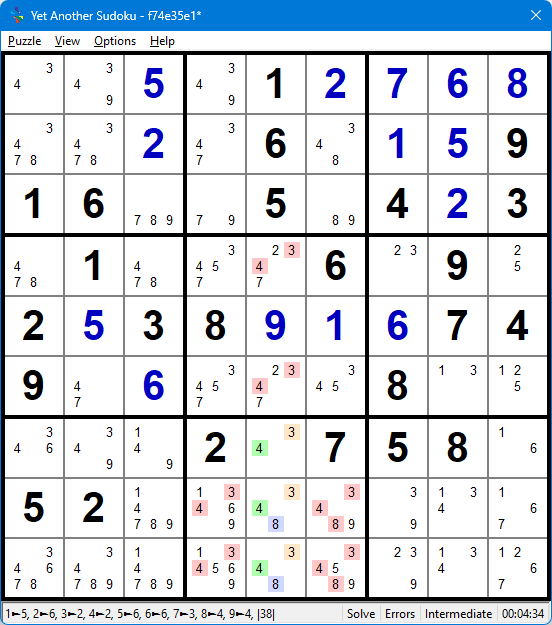
Figure 3.51: Locked Exposed Triple#
The Locked Exposed Triple in Figure 3.51: has the following Base Sets:
Br7c5 = {3r7c5, 4r7c5},Br8c5 = {3r8c5, 4r8c5, 8r8c5}, andBr9c5 = {3r9c5, 4r9c5, 8r9c5}.
The Link Sets are:
L3c5 = {3r7c5, 3r8c5, 3r9c5},L4c5 = {4r7c5, 4r8c5, 4r9c5}, andL8c5 = {8r8c5, 8r9c5}.
And the Cover Sets in Column 4 are:
C3c5 = {3r4c5, 3r6c5, 3r7c5, 3r8c5, 3r9c5},C4c5 = {4r4c5, 4r6c5, 4r7c5, 4r8c5, 4r9c5}, andC8c5 = {8r4c5, 8r6c5, 8r8c5, 8r9c5}.
And notice that this pattern is also locked to Box 8
C3b8 = {3r7c5, 3r8c4, 3r8c5, 3r8c6, 3r9c4, 3r9c5, 3r9c6},C4b8 = {4r7c5, 4r8c4, 4r8c5, 4r8c6, 4r9c4, 4r9c5, 4r9c6}, andC8b8 = {8r9c5, 8r9c6}.
The set unions are:
Bu = {3r7c5, 4r7c5, 3r8c5, 4r8c5, 8r8c5, 3r9c5, 4r9c5, 8r9c5},Lu = {3r7c5, 3r8c5, 3r9c5, 4r7c5, 4r8c5, 4r9c5, 8r8c5, 8r9c5}, andCU = {3r4c5, 3r6c5, 3r7c5, 3r8c4, 3r8c5, 3r8c6, 3r9c4, 3r9c5, 3r9c6, 4r4c5, 4r6c5, 4r7c5, 4r8c4, 4r8c5, 4r8c6, 4r9c4, 4r9c5 4r9c6, 8r4c5, 8r6c5, 8r8c5, 8r8c6, 8r9c5, 8r9c6}.
Applying the Sudoku Rule:
IF (BU == LU):    # Evaluates True
   THEN Elims = CU - BU  # Compute Eliminations
             = {3r4c5, 3r6c5, 3r7c5, 3r8c4, 3r8c5, 3r8c6, 3r9c4, 3r9c5, 3r9c6, 4r4c5, 4r6c5, 4r7c5, 4r8c4, 4r8c5, 4r8c6, 4r9c4, 4r9c5, 4r9c6, 8r4c5, 8r6c5, 8r8c5, 8r8c6, 8r9c5, 8r9c6} - {3r7c5, 3r8c5, 3r9c5, 4r7c5, 4r8c5, 4r9c5, 8r8c5, 8r9c5}
             = {3r4c5, 3r6c5, 3r8c4, 3r8c6, 3r9c4, 3r9c6, 4r4c5, 4r6c5, 4r8c4, 4r8c6, 4r9c4, 4r9c6, 8r8c6, 8r9c6}
An unusually productive 14 Ccell Elimination.
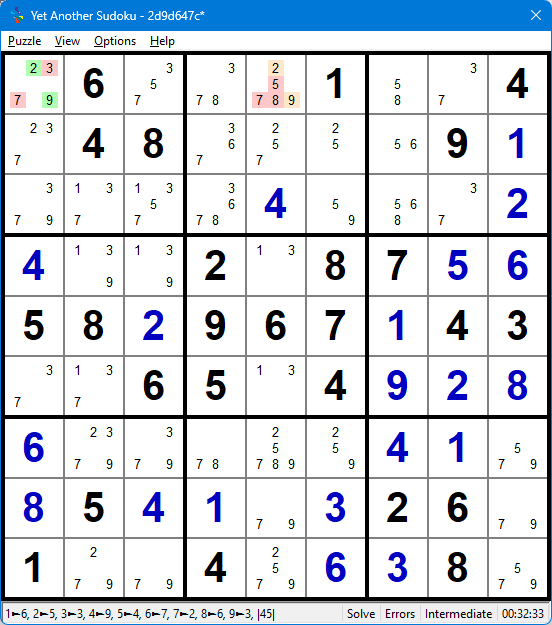
3.8.3.1.4. Rank 0 Swordfish Example#
Fish are single Candidate value patterns. Base Sets are Sets of same value Ccell Truths each in their own House. Link Sets connect Ccells from the Base Sets in non-Base Set Houses.
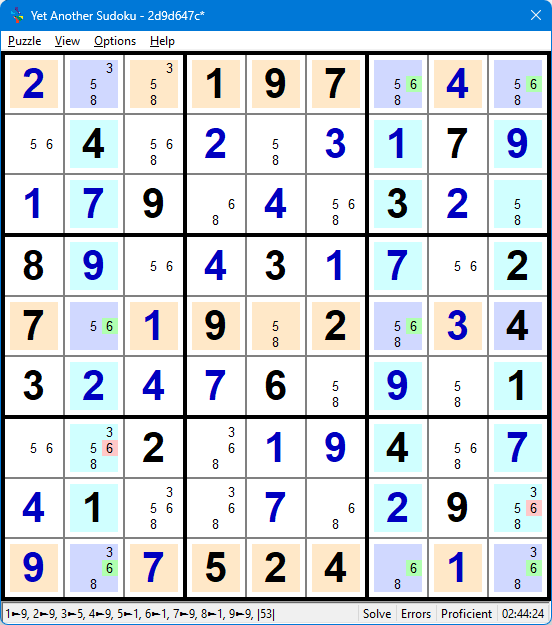
Figure 3.53: Swordfish#
The Candidate 6 Swordfish in Figure 3.53: , Base Set Houses are highlighted beigé, Link Set Houses highlighted cyan, and intersections highlighted light purple. The Base Sets are:
B6r1 = {6r1c7, 6r1c9},B6r5 = {6r5c2, 6r5c7}, andB6r9 = {6r9c2, 6r9c7, 6r9c9}.
The Link Sets are:
L6c2 = {6r5c2, 6r9c2},L6c7 = {6r1c7, 6r5c7, 6r9c7}, andL6c9 = {6r1c9, 6r9c9}.
And the Cover Sets in Column 4 are:
C3c5 = {6r5c2, 6r7c2, 6r9c2},C4c5 = {6r1c7, 6r5c7, 6r9c7}, andC8c5 = {6r1c9, 6r8c9, 6r9c9}.
The set unions are:
Bu = {6r1c7, 6r1c9, 6r5c2, 6r5c7, 6r9c2, 6r9c7, 6r9c9},Lu = {6r5c2, 6r9c2, 6r1c7, 6r5c7, 6r9c7, 6r1c9, 6r9c9}, andCU = {6r5c2, 6r7c2, 6r9c2, 6r1c7, 6r5c7, 6r9c7, 6r1c9, 6r8c9, 6r9c9}.
Applying the Sudoku Rule:
IF (BU == LU):    # Evaluates True
   THEN Elims = CU - BU  # Compute Eliminations
             = {6r5c2, 6r7c2, 6r9c2, 6r1c7, 6r5c7, 6r9c7, 6r1c9, 6r8c9, 6r9c9} - {6r5c2, 6r9c2, 6r2c7, 6r5c7, 6r9c7, 6r2c9, 6r9c9}
             = {6r7c2, 6r8c9}
3.8.3.1.5. Rank 0 Even Loop Example#
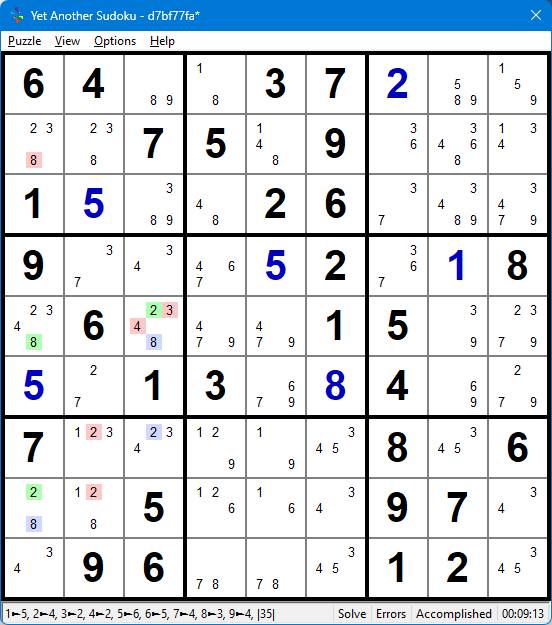
Figure 3.54: Even Loop#
Strong Sets are indicated by green to blue Ccells, Link Sets by blue to green Ccells. Characteristic of all AI Chains Both All Base Sets and Link Sets only contain 2 Ccells each.
The Base Sets are:
B2c3 = {2r5c3, 2r7c3},Br8c2 = {2r8c1, 8r8c1}, andB8r5 = {8r5c1, 8r5c3}. and
The Link Sets are:
L2b7 = {2r7c3, 2r8c1},L8r1 = {8r8c1, 8r5c1}, andLr5c3 = {2r5c3, 8r5c3}.
And the corresponding Cover Sets in Column 4 are:
L2b7 = {2r7c2, 2r7c3, 2r1c8, 2r8c2},L8r1 = {8r8c1, 8r5c1}, andLr5c3 = {2r5c3, 3r5c3, 4r5c3, 8r5c3}.
The set unions are:
Bu = {2r5c3, 2r7c3, 2r8c1, 8r8c1, 8r5c1, 8r5c3},Lu = {2r7c3, 2r8c1, 8r8c1, 8r5c1, 2r5c3, 8r5c3}, andCU = {2r7c2, 2r7c3, 2r8c1, 8r8c1, 8r5c1, 2r5c3, 3r5c3, 4r5c3, 8r5c3}.
Applying the Sudoku Rule:
IF (BU == LU):    # Evaluates True
   THEN Elims = CU - BU  # Compute Eliminations
             = {2r7c2, 2r7c3, 2r8c1, 8r8c1, 8r5c1, 2r5c3, 3r5c3, 4r5c3, 8r5c3} - {2r5c3, 2r7c3, 2r8c1, 8r8c1, 8r5c1, 8r5c3}
             = {2r7c2, 2r8c2, 3r5c3, 4r5c3}
3.8.3.2. Rank 1 Patterns#
Rank 1 patterns need a minimum of ‘n + 1’ Link Sets to intersect all the Base Set Ccells
Rank 1 patterns have ‘n’ non-intersecting Base Sets with all their Ccells are intersected by a minimum of ‘n + 1’ Link Sets. Therefore, the union of any two Link Sets will always see a complete Base Set Truth. Consequently, where ever two Link Sets overlap, any non-Base Set Ccell in the Intersection of those Cover Sets cannot be True and is eliminated.
Many “Human Solvable” patterns are Rank 1 patterns. These include Bent Subsets, Finned Fish, Sashimi Fish, AI Chains in many of their forms, and Nearly Locked Sets.
The Sudoku Rule as a formula for Rank 1 patterns:
Base Set  Bi  = {P, Q, R, ...}    # P, Q, R, ... are the Ccells making up the Truth in the Base Set Bi
Base Set BU = U(B1, B1, ...,Bn)    # The union of Base Sets B1, B2, ..., Bn
Link Set Li = {K, M, N, ...}    # K, M, N, ... Links Ccells from the Base Set Union that see each other in a non-Base Set Chouse
Link Set LU = U(L1, L1, ..., Ln+1)    # The union of Link Sets L1, L2, ..., Ln+1
Cover Set Ci = {K, M, N, S, T, ...}    # Contains all the Ccells that See each other in the Link Set House Li
Cover Set CU = U(C1, C1, ..., Cn+1)    # The union of Cover Sets C1, C2, ..., Cn+1

IF (BU == LU):    # if all the Base Set Ccells are Linked
   THEN Elims = (Union of (Intersections of all Combinations of 2 Cover Sets)) - BU
Any Ccell in the occupied Intersected Cover Set Pair that is not of the Union of Base Set CCells cannot be True and is eliminated.
A quick way to find the union of intersections is to scan the list of cover sets to find all those Ccells that occur more than once, no Ccell should appear more than twice in the list. Then remove those that are in the Base Set Union. What’s left is the eliminations.
3.8.3.2.1. Rank 1 Finned X Wing Example#
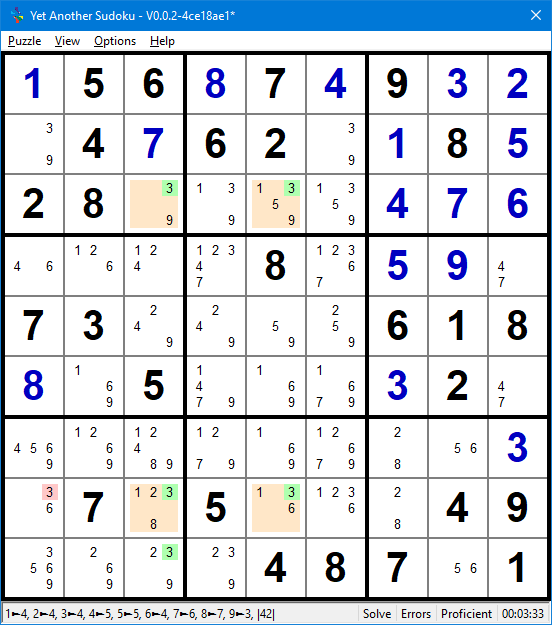
Figure 3.55: Finned X-Wing#
The Rank 1 puzzle pattern on the right is a Finned X-Wing 3c35r38,r9c3.
The Base Sets are:
B3c3 = {3r3c3, 3r8c3, 3r9c3}, andB3c5 = {3r3c5, 3r8c5}.
The Link Sets are:
L3r3 = {3r3c3, 3r3c5},L3r8 = {3r8c3, 3r8c5}, andL3b7 = {3r8r3, 3r9c3}.
And the Cover Sets are:
C3r3 = {3r3c3, 3r3c4, 3r3c5, 3r3c6},C3r8 = {3r8c1, 3r8c3, 3r8c5, 3r8c6}, andC3b7 = {3r8c1, 3r8r3, 3r9c1, 3r9c3}.
Applying the Sudoku Rule:
IF (BU == LU):    # Evaluates True
   THEN Elims = (C3r8 & C3b7) - BU  # Compute Eliminations
              = ({3r8c1, 3r8c3, 3r8c5, 3r8c6} & {3r8c1, 3r8r3, 3r9c1, 3r9c3}) - {3r3c3, 3r8c3, 3r9c3, 3r3c5, 3r8c5}
              = {3r8c1, 3r8c3} - {3r3c3, 3r8c3, 3r9c3, 3r3c5, 3r8c5}
              = {3r8c1}
The intersection of C3r8 & C3b7
is the only intersection of pairs of Link Sets that yields an occupied set.
Double-checking this result intuitively, either the Fish pattern will be True or the Fin will be True. Therefore, any Ccell that is any Cover Set Ccell outside the intersections that can also see the Fin cannot be True and can be eliminated.
3.8.3.2.2. Rank 1 Two String Kite Example#
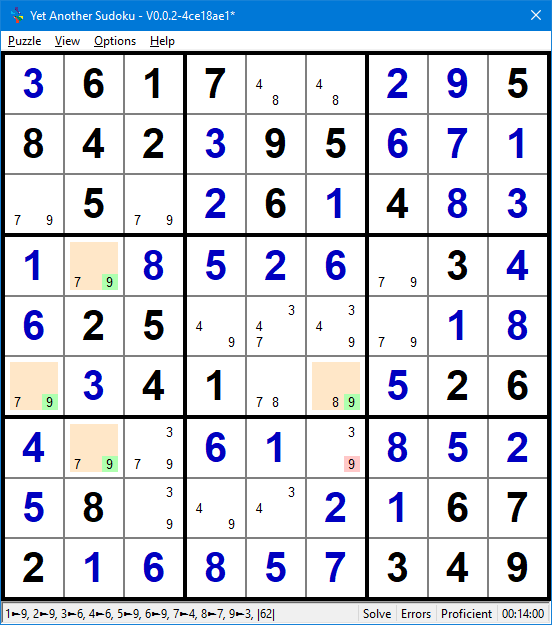
Figure 3.56: Two String Kite#
The Rank 1 puzzle pattern on the right is a Two String Kite
9(r6c6=r6c1-r4c2=r7c2). This pattern is also an example of two base sets
crossing over each other without intersecting.
The two Base Sets for Candidate 9 are:
B9r7 = {9r6c1, 9r6c6}, andB9c2 = {9r4c2, 9r7c2}.
The Link Sets are:
L9b4 = {9r6c1, 9r4c2},L9r7|9b7|r7c2 = {9r7c2}, andL9c6|9b5|r6c6 = {9r6c6}.
Note: The last two Link Sets are single Ccell sets. An interesting property of Single Ccell Link Sets, is that they are not bound to any house, they are visible from all the remaining non-Base Set Chouses, as indicated in the subscript.
And the Cover Sets are:
C9b4 = {9r6c1, 9r4c2},C9r7|9b7|r7c2 = {9r7c2, 9r7c3, 9r7c6, 9r8c3, 7r7c2}, andC9c6|9b5|r6c6 = {9r5c6, 9r6c6, 9r7c6, 9r5c4, 8r6c6}.
Applying the Sudoku Rule:
IF (BU == LU):    # Evaluates True
   THEN Elims = (C9r7|9b7|r7c2 & C9c6|9b5|r6c6) - BU  # Compute Eliminations
              = ({9r7c2, 9r7c3, 9r7c6} & {9r5c6, 9r6c6, 9r7c6}) - {9r6c1, 9r6c6, 9r4c2, 9r7c2}
              = {9r7c6} - {9r6c1, 9r6c6, 9r4c2, 9r7c2}
              = {9r7c6}
The intersection of C9r7|9b7|r7c2 & C9c6|9b5|r6c6
is the only intersection of pairs of Link Sets that yields an occupied set.
Resolving as a Two String Kite, if 9r6c6 is False, 9r6c2 is True, 9r4c2 is False, and 9r2c7
is True. Similarly walking the links in the opposite direction, if 9r2c7 is False, then
9r6c6 is True. Thus, there is a Robust link 9r6c6|~|9r7c2.
At least one end of a Robust Link must be True, therefore any Ccell such as 9r7c6 that sees both
ends cannot be True and is eliminated.
3.8.3.2.3. Rank 1 Nearly Locked Set or XY Chain Example#
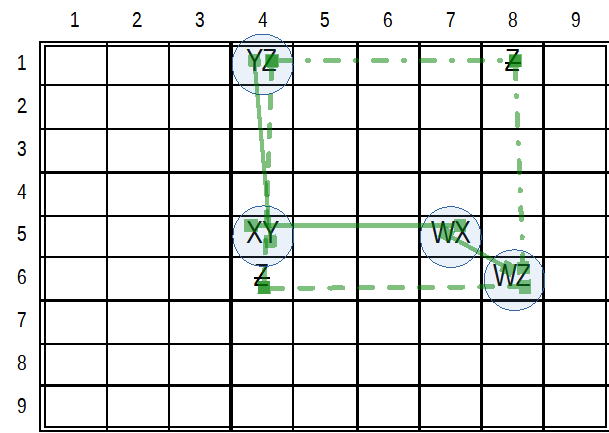
Figure 3.57: Unlocked Set Chain Candidate Diagram#
The Rank 1 Puzzle pattern on the right is also both an XY-Chain:
(Z=Y)r1c4~(Y=X)r5c4~(X=W)r5c7~(W=Z)r6c8, and a 2 Node Unlocked Set Chain:
Z(YZr1c4,XYr5c4)X(WXr5c7,WZr6c8)Z.
As a Rank 1 GMOP, identify the Bi-value Cells as the Base Sets:
Br1c4 = {Yr1c4, Zr1c4},Br5c4 = {Xr5c4, Yr5c4}Br5c7 = {Wr5c7, Xr5c7}, andBr6c8 = {Wr6c8, Zr6c8}.
The Link Sets are:
LWb6 = {Wr5c7, Wr6c8},LXr5 = {Xr5c4, Xr5c7},LYc4 = {Yr1c4, Yr5c4},LZr1|Zc4|Zb2 = {Zr1c4}, andLZr6|Zc8|Zb6 = {Zr6c8}.
And the Cover Sets are:
LWb6 = {Wr5c7, Wr6c8},LXr5 = {Xr5c4, Xr5c7},LYc4 = {Yr1c4, Yr5c4},LZr1|Zc4|Zb2 = {Zr1c4, Zr1c8, Zr6c4}, andLZc8|Zc8|Zb6 = {Zr6c8, Zr1c8, Zr6c4}.
Applying the Sudoku Rule:
IF (BU == LU):    # Evaluates True
   THEN Elims = (CZr1|Zc4|Zb2 & CZc8|Zc8|Zb6) - BU  # Compute Eliminations
              = ({Zr1c4, Zr1c8, Zr6c4} & {Zr6c8, Zr1c8, Zr6c4}) - {Yr1c4, Zr1c4, Xr5c4, Yr5c4, Wr5c7, Xr5c7, Wr6c8, Zr6c8}
              = {Zr1c8, Zr6c4} - {Yr1c4, Zr1c4, Xr5c4, Yr5c4, Wr5c7, Xr5c7, Wr6c8, Zr6c8}
              = {Zr1c8, Zr6c4}
The intersection of CZc8|Zc8|Zb6 & CZc8|Zc8|Zb6
is the only intersection of pairs of Link Sets that yields an occupied set.
elimination of Zr1c8.
As an XY Chain the Ccells in the Bi Value cells are the Strong links of the AI Chain. They are
weakly linked by a common value Ccell connecting two Bi Value Ccells. The Chain ends are Zr1c4
and Zr6c8 and the Chain ensures that neither end is simultaneously False, at least one end is True,
which it is yet to be determined. Therefore, any Ccell that can see both ends of the chain
cannot be True, and is eliminated.
As the 2 Node Unlocked Set Chain, X is the only member in the RCS connecting the two ULS’s. The
other common candidate is “Z”. If X is True in the first ULS, then Z is True in ULS2, and if X is
True in the second ULS, then Z is True in the first ULS. This locks Zr1c4 and Zr6c8 are locked
into “A Truth”. Therefore, any same valued (Z) Ccell that can see all the elements of this
‘A Truth’ cannot be True and can be eliminated.
3.8.3.3. Rank ‘r’ Patterns#
Rank r patterns have ‘n’ non-intersecting Base Sets with all their Ccells are intersected by a minimum of ‘n + r’ Link Sets. Therefore, the union of any ‘r + 1’ Link Sets will always see a complete Base Set Truth. Consequently, where ever ‘r + 1’ Link Sets overlap, any non-Base Set Ccell in the Intersection of those Cover Sets cannot be True and is eliminated.
The Sudoku Rule as a formula for Rank ‘r’ patterns:
Base Set  Bi  = {P, Q, R, ...}    # P, Q, R, ... are the Ccells making up the Truth in the Base Set Bi
Base Set BU = U(B1, B1, ...,Bn)    # The union of Base Sets B1, B2, ..., Bn
Link Set Li = {K, M, N, ...}    # K, M, N, ... Links Ccells from the Base Set Union that see each other in a non-Base Set Chouse
Link Set LU = U(L1, L1, ..., Ln+r)    # The union of Link Sets L1, L2, ..., Ln+1
Cover Set Ci = {K, M, N, S, T, ...}    # Contains all the Ccells that See each other in the Link Set House Li
Cover Set CU = U(C1, C1, ..., Cn+r)    # The union of Cover Sets C1, C2, ..., Cn+1

IF (BU == LU):    # if all the Base Set Ccells are Linked
   THEN Elims = (Union of (Intersections of all Combinations of 'r + 1' Cover Sets)) - BU
Sudoku puzzles exist in a three-dimensional space where each Ccell is uniquely identified by its value-row-column tuple.
Ccells are members of Sets. A Set are collections of Ccells that See each other in a Chouse. A Chouse is one of a Row, Column, Box or Cell. Every Ccell is a member of four Sets:
The Ccells it sees in a Row
The Ccells it sees in a Column
The Ccells it sees in a Box
The Ccells it sees in a Cell
Constrained to four intersections, any pattern greater than Rank 3 requires additional logic:
A Link Triplet is a CCell that lies in the intersection of two Link Sets and a Base Set. This Ccell is key to reducing the rank by one of a Link Set that intersects that Triplet Base Set.
Relax the Intersecting Base Sets constraint and seek out both Link Triplets and Base Triplets A Base Triplet is a Ccell that lies in the intersection of two Base Sets and a Link Set. This Ccell is key to reducing the rank by one of a Base Set that intersects that Triplet Base Set.
FIXUP
3.8.3.3.1. Triplets and Rank#
3.8.3.3.1.1. Base Triplets#
3.8.3.3.1.2. Link Triplets#
3.8.3.3.1.3. Rank Regions#
3.8.3.3.1.4. Additive Properties of Triplets#
3.8.3.3.2. The art of Identifying Rank ‘r’ Patterns#
3.8.3.3.3. Rank ‘r’ Examples#
So if you have the fortitude and inclination, get yourself a cuppa, a pencil and a ream of paper. rest of this section walks through Allan Barker’s solution of the Easter Monster, and Golden Nugget, each acknowledged as one of the Hardest Sudoku Puzzles..